Get ready for the 2025 WAEC Agricultural Science exam with these accurate and easy-to-understand answers. This guide provides the exact solutions for the Objective (OBJ) and Essay sections, presented in a clear format to help students study effectively.
Agricultural Science Objective (OBJ) Solutions
Below are the verified answers for the 2025 WAEC Agricultural Science OBJ section:
- 01–10: CABDBDDABC
- 11–20: DADABABBDB
- 21–30: CCCACABBDC
- 31–40: BCDDCBDCCA
- 41–50: DCCACBBCAD
Agricultural Science Essay Solutions
Question 1: Food Security and Mechanization
1(a) Factors Affecting Food Security in West Africa
(i) Conflict and Political Instability
(ii) Environmental Challenges
(iii) Population Growth
(iv) Poverty
(v) Unfair Trading Structures
(vi) Diseases
1(b) Organizations Supporting Agriculture
(i) ECOWAS (Economic Community of West African States)
(ii) West African Agricultural Productivity Program (WAAPP)
(iii) National Agricultural Research Systems (NARS)
(iv) Ministry of Agriculture
1(c)(i) Land Preparation Activities Using Tractors
(i) Plowing
(ii) Planting
(iii) Harvesting
1(c)(ii) Challenges of Using Tractors
(i) High Costs: Tractors are expensive, making it challenging for small-scale farmers to afford them.
(ii) Limited Access to Credit: Farmers may not have access to credit or financing options to purchase tractors.
(iii) Maintenance and Repair: Tractors require regular maintenance and repair, which can be challenging in areas with limited infrastructure.
(iv) Fuel and Operating Costs: Tractors require fuel and regular maintenance, which can be costly.
(v) Availability and Distribution: Tractors may not be readily available or widely distributed in rural areas, making it difficult for farmers to access them.
Question 2: Soil Fertility and Environmental Impact
2(a) Causes of Nutrient Loss in Soil
(i) Leaching: Nutrients can be leached from the soil by excessive rainfall or irrigation, leading to nutrient loss.
(ii) Crop removal: Harvesting crops can remove nutrients from the soil, especially if the crops are not returned to the soil as organic matter.
(iii) Erosion: Soil erosion can lead to nutrient loss, as topsoil is often rich in nutrients.
(iv) Continuous cultivation: Continuous cultivation without adequate nutrient replenishment can lead to nutrient depletion.
2(b)(i) Advantages of Green Manure
(i) Nutrient addition: Green manure adds nutrients to the soil, improving soil fertility.
(ii) Soil structure improvement: Green manure can improve soil structure, increasing water-holding capacity and aeration.
(iii) Increased microbial activity: Green manure provides a food source for beneficial microorganisms, promoting soil health.
2(b)(ii) Disadvantages of Green Manure
(i) Labor requirements: Incorporating green manure into the soil can be labor-intensive.
(ii) Competition with crops: Green manure crops can compete with other crops for water and nutrients.
(iii) Potential for weediness: Some green manure crops can become weeds if not managed properly.
2(c) Effects of Deforestation
(i) Loss of biodiversity: Deforestation can lead to the loss of biodiversity, as forests are home to a wide range of plant and animal species.
(ii) Soil erosion: Deforestation can lead to soil erosion, as tree roots help hold soil in place.
(iii) Climate change: Deforestation contributes to climate change, as forests play a crucial role in regulating the climate.
(iv) Indigenous community displacement: Deforestation can lead to the displacement of indigenous communities, who often depend on forests for their livelihoods.
Question 3: Environmental Factors in Agriculture
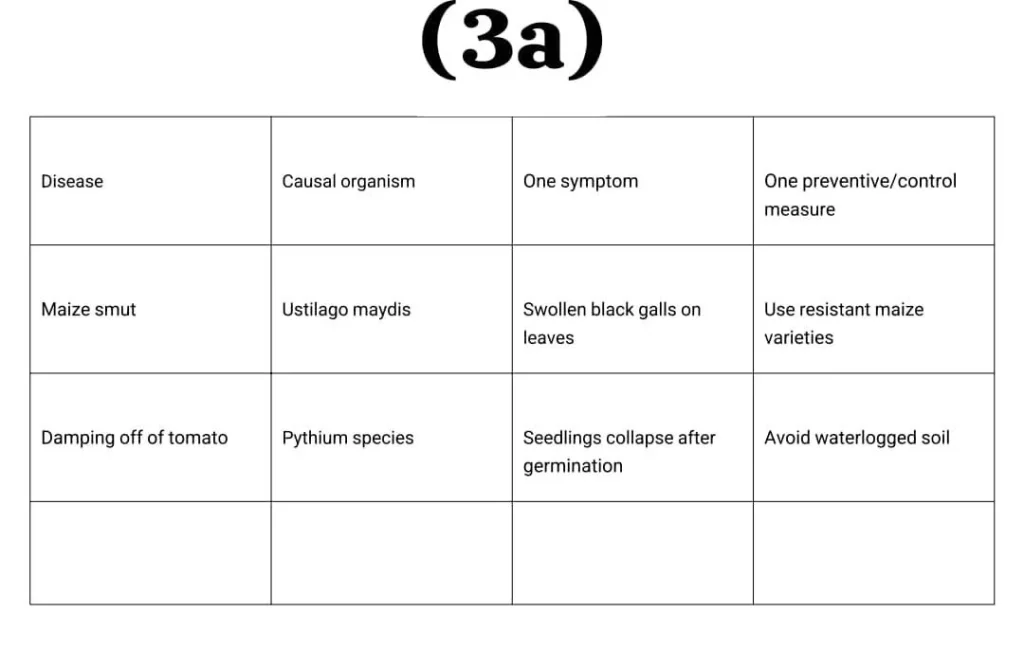
3(a) Table Completion
3(b)(i) Effects of Wind
(PICK FOUR ONLY)
(i) It causes mechanical damage to crops.
(ii) It leads to lodging of tall crops like maize and sorghum.
(iii) It increases the rate of evapotranspiration.
(iv) It helps in the dispersal of pollen for pollination.
(v) It can spread pests and diseases.
(vi) It contributes to soil erosion.
(vii) It can aid in seed dispersal.
(viii) Strong winds can destroy farm infrastructure such as greenhouses.
3(b)(ii) Effects of Light
(PICK FOUR ONLY)
(i) It is essential for photosynthesis in crops.
(ii) Inadequate light reduces crop yield.
(iii) It influences flowering and fruiting in plants.
(iv) Light duration affects vegetative growth.
(v) Excessive sunlight can cause wilting and scorching.
(vi) It affects the opening and closing of stomata.
(vii) Light intensity influences plant pigmentation.
(viii) It helps in regulating plant circadian rhythms.
3(c) Causes of Deforestation
(PICK FOUR ONLY)
(i) Logging for timber and firewood.
(ii) Bush burning.
(iii) Farming and agricultural expansion.
(iv) Urbanization and construction.
(v) Mining activities.
(vi) Road construction.
(vii) Industrial development.
(viii) Charcoal production.
Question 4: Cotton Production
4(a)(i) Planting Material
Cotton seeds are the primary planting material. These seeds can be genetically modified or non-genetically modified, depending on the variety. Seed treatment is often done to protect against pests and diseases.
4(a)(ii) Spacing for Cotton
The spacing for cotton plants varies depending on the variety and growing conditions. For American cotton, a spacing of 75×15 cm is recommended under irrigated conditions, while 60×30 cm is used under rain-fed conditions.
4(a)(iii) Cotton Varieties
(i) RCH 134 BT
(ii) MRC 6301 BT
4(a)(iv) Harvesting
Cotton is typically harvested when the bolls are mature and open. The harvesting season usually occurs between August and September, depending on the local climate.
4(a)(v) Cotton Pests
(i) Pink Bollworm
(ii) Tobacco Caterpillar
4(a)(vi) Uses of Cotton
(i) Textile production
(ii) Industrial applications
4(b) Benefits of New Crop Varieties
(i) Improved yield: New varieties can offer higher yields, increasing productivity and profitability for farmers.
(ii) Disease resistance: Some new varieties may possess resistance to certain diseases, reducing crop losses and pesticide use.
(iii) Enhanced quality: New varieties can have improved taste, texture, or appearance, making them more desirable for consumers.
(iv) Increased market opportunities: Introducing new varieties can open up new market opportunities, both domestically and internationally.
(v) Climate resilience: Some new varieties may be bred to be more resilient to climate change, helping farmers adapt to changing environmental conditions.
4(c) Fish Pond Management
(i) Feeding management
(ii) Water management
(iii) Health monitoring
(iv) Cage maintenance
Question 5: Pasture and Livestock Management
5(a)(i) Importance of Fencing
(PICK ANY THREE)
(i) Prevents animals from straying or escaping.
(ii) Protects pasture from overgrazing by controlling access.
(iii) Prevents theft or loss of livestock.
(iv) Keeps out predators and trespassers.
(v) Helps in rotational grazing by dividing the land into paddocks.
(vi) Protects young or newly established pasture from being grazed prematurely.
5(a)(ii) Benefits of Adequate Stocking
(PICK ANY THREE)
(i) Prevents overgrazing and degradation of pasture.
(ii) Ensures animals get enough feed and maintain good health.
(iii) Maintains soil fertility and reduces erosion.
(iv) Enhances uniform utilization of pasture.
(v) Promotes regrowth of pasture grasses.
(vi) Helps in better planning and management of farm resources.
5(b)(i) Culling
Culling: This is the process of removing unproductive, sick, or undesirable animals from a herd or flock to improve the overall quality and productivity.
5(b)(ii) Dehorning
Dehorning is the removal of horns from animals (especially cattle and goats) to prevent injuries to other animals and handlers and to reduce space requirements in housing and transport.
5(b)(iii) Castration
Castration is the removal or inactivation of the testes in male animals to prevent breeding, reduce aggression, and improve the quality of meat.
5(c) Steps in Pasture Establishment
(i) Seed selection
(ii) Pre-germination
(iii) Sowing
(iv) Watering
(v) Shading
(vi) Weeding and pest control
(vii) Transplanting
Question 6: Farm Economics and Weed Management
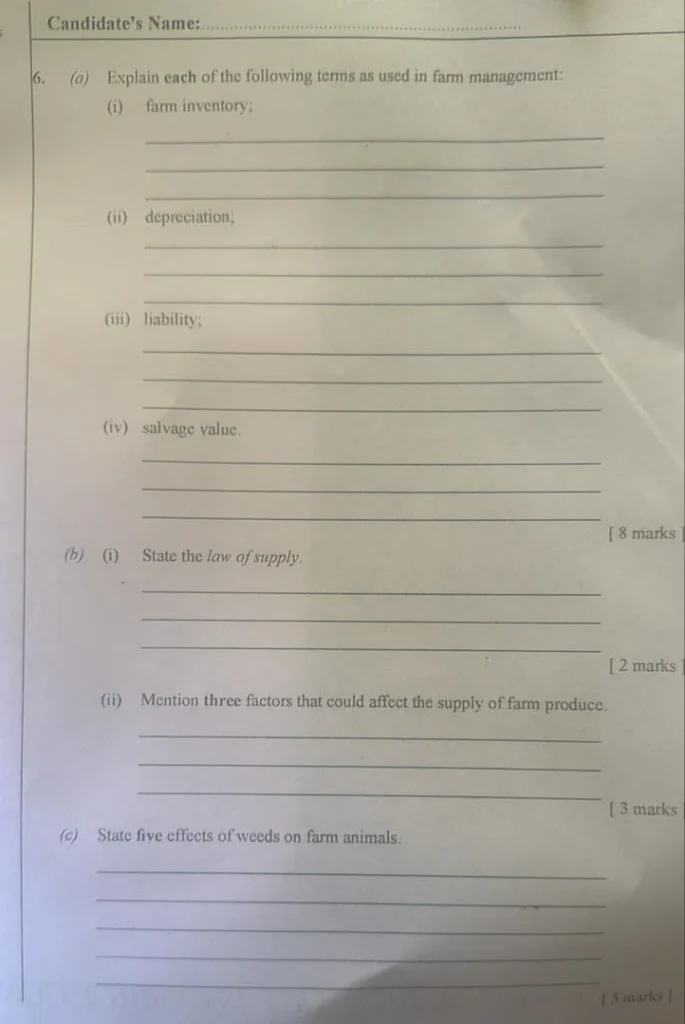
6(a)(i) Farm Inventory
Farm inventory: A detailed list of all the assets and items on a farm, including machinery, tools, livestock, crops, and other materials, used to assess the farm’s worth and aid in management decisions.
6(a)(ii) Depreciation
Depreciation: The reduction in the value of a farm asset over time due to wear and tear, age, or obsolescence. It is used to calculate the current value of assets.
6(a)(iii) Liability
Liability: The financial obligations or debts that a farm owes to external parties, such as loans, mortgages, or unpaid bills.
6(a)(iv) Salvage Value
Salvage value: The estimated residual value of an asset at the end of its useful life, which can be recovered by selling or disposing of the asset.
6(b)(i) Law of Supply
The law of supply states that, all other factors being equal, the quantity of a good supplied increases as the market price increases, and decreases as the market price decreases.
6(b)(ii) Factors Affecting Supply
(PICK ANY THREE)
(i) Weather conditions
(ii) Availability and cost of farm inputs
(iii) Government policies
(iv) Price of farm produce in the market
(v) Availability of labor
(vi) Technological advancement
(vii) Storage and transportation facilities
6(c) Effects of Weeds on Pasture
(PICK ANY FIVE)
(i) Weeds can harbor pests and diseases harmful to animals
(ii) Some weeds are poisonous and can cause illness or death if consumed
(iii) Weeds reduce the quality of pasture available for grazing
(iv) Dense weed growth can restrict animal movement and access to water or feed
(v) Increased cost of pasture management due to the need for weed control
(vi) Some weeds have thorns or spines that can injure animals
(vii) Weeds may outcompete nutritious pasture grasses
(viii) Weeds may reduce the palatability of pasture
(ix) Infestation of invasive weeds may lower the overall carrying capacity of grazing land