Access the full NECO Stenography Practical Answers for 2025 here. This page will be updated with accurate solutions to the Practical questions before the exam starts. Refresh the page regularly to get the latest updates as they are released.
NECO Stenography Practical Answers 2025
Number 1
Answers Loading…
==================
Number 2
Answers Loading…
==================
Number 3
Answers Loading…
==================
Number 4
Answers Loading…
==================
Number 5
Answers Loading…
🔄 Answers Loading…
Please refresh this page every few minutes to see new updates.
Access the full NECO Biology Practical Questions and Answers for 2025 here. This page will be updated with accurate solutions to both objective and practical questions before the exam begins. Refresh the page regularly to get the latest answers as they drop.
Neco Biology Practical Answers 2025
Number 1
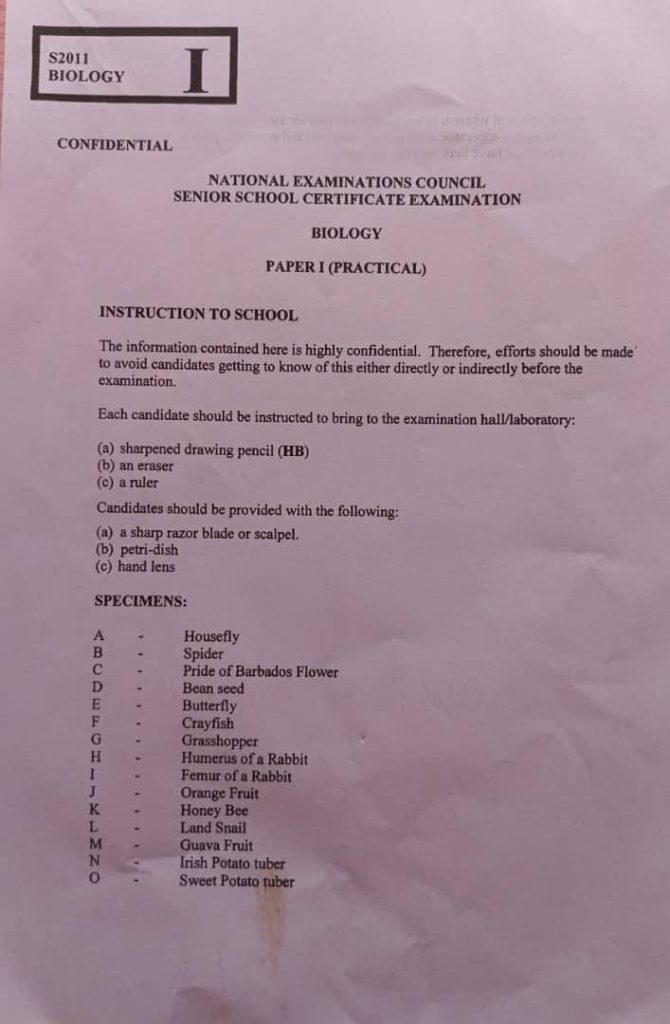
(1ai) A: Housefly B; Spider C; Pride of Barbados Flower D; Bean seed E; Butterfly
(1aii) Specimen; A; – Insecta
Specimen; B; – Arachnida
(1bi) (i)Typhoid fever (ii)Dysentery
(1bii) (i)Spongy proboscis. (ii)Hairy body and legs.
(1biii) Specimen; A; (i)Housefly have six legs (like all insects) (ii)Housefly have a distinct head, thorax, and abdomen
Specimen; B; (i)spiders have eight legs. (ii)spiders have a cephalothorax and abdomen.
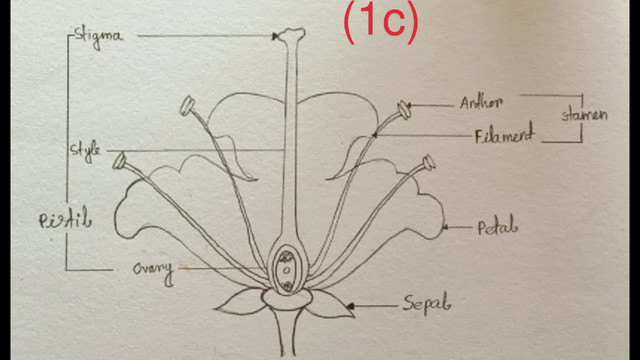
(1ci)
(1cii) Insecta
(1ciii) (i)Colorful wings: With scales that give them vibrant colors and patterns. (ii)Proboscis: A long, coiled tube used for feeding on nectar. (iii)Compound eyes: Large eyes that provide wide-angle vision. (iv)Antennae: Used for sensing the environment.
(1civ) As they feed on nectar from flowers, they transfer pollen from one flower to another, facilitating the reproduction of the plant.
(1cv) (i)Proboscis: Allows them to reach nectar deep within flowers, coming into contact with pollen. (ii)Hairy body: Pollen can stick to their bodies and be transferred to other flowers.
==================
Number 2
(2ai) F; Crayfish G; Grasshopper H; Humerus of a Rabbit I; Femur of a Rabbit J; Orange Fruit
(2aii) Specimen; F; Malacostraca
Specimen; G; Insecta
(2aiii) Food Source: Crayfish are an important food source for humans and are commercially harvested or farmed in many parts of the world.
(2aiv) Specimen; F; (i)They are primarily aquatic, living in freshwater or saltwater environments (ii)They have gills for breathing underwater to survive.
Specimen; G; (i)They are terrestrial, living on land. (ii)They have a tracheal system for breathing air directly to their tissues.
(2bi) Specimen; H; Located in the upper arm (forelimb), connecting the shoulder to the elbow.
Specimen; I; Located in the thigh (hindlimb), connecting the hip to the knee.
(2bii) (i)Scapula (shoulder blade) (ii)Radius and Ulna
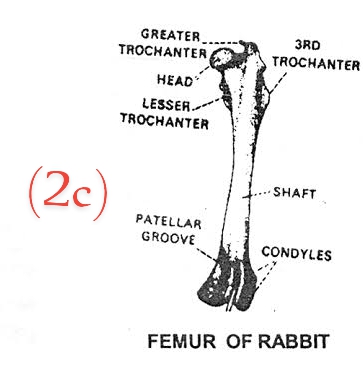
(2c)
==================
Number 3
(3ai) K; Honey Bee L; Land Snail M; Guava Fruit N; Irish Potato tuber O; Sweet Potato tuber
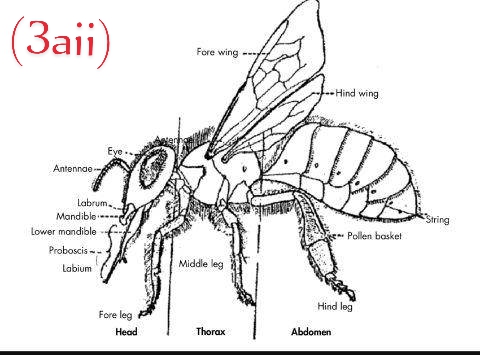
(3aii)
(3bi) Specimen; K; Insecta
Specimen; L; Gastropoda
(3bii) (i)Shell: Presence of a spiral shell for protection. (ii)Foot: A flat, muscular foot used for locomotion. (iii)Tentacles: Presence of tentacles on the head for sensory purposes. (iv)Radula: A radula (a tongue-like structure with tiny teeth) used for feeding.
(3biii) Specimen; K; Production of honey and pollination services.
Specimen; L; Some species are considered a delicacy and are farmed for food (escargot), contributing to local economies.
(3biv) The type of placentation observed is axile placentation.
(3ci) Specimen; N; Stem tuber
Specimen; O; Root tuber
(3cii) Irish potatoes are propagated by vegetative propagation, specifically by planting seed potatoes (pieces of the tuber containing “eyes”).
Access the full Storekeeping Questions and Answers for 2025 here. This page will be updated with accurate solutions to both objective and essay questions before the exam starts. Refresh the page regularly to see the latest answers.
NECO Storekeeping OBJ 2025
1-10: ————————–
11-20: ————————-
21-30: ————————
31-40: ————————
Solving/Typing…
NECO Storekeeping Essay 2025
Number 1
Answers Loading…
==================
Number 2
Answers Loading…
==================
Number 3
Answers Loading…
==================
Number 4
Answers Loading…
==================
Number 5
Answers Loading…
🔄 Answers Loading…
Please refresh this page every few minutes to see new updates.
Access the full WAEC Physics answers for 2025 here. This page will be updated with verified and accurate solutions to both the objective (OBJ) and essay questions before the exam begins.
Stay tuned and refresh this page regularly to get the latest answers and explanations as they are posted. We are committed to helping you perform excellently in your Physics paper.
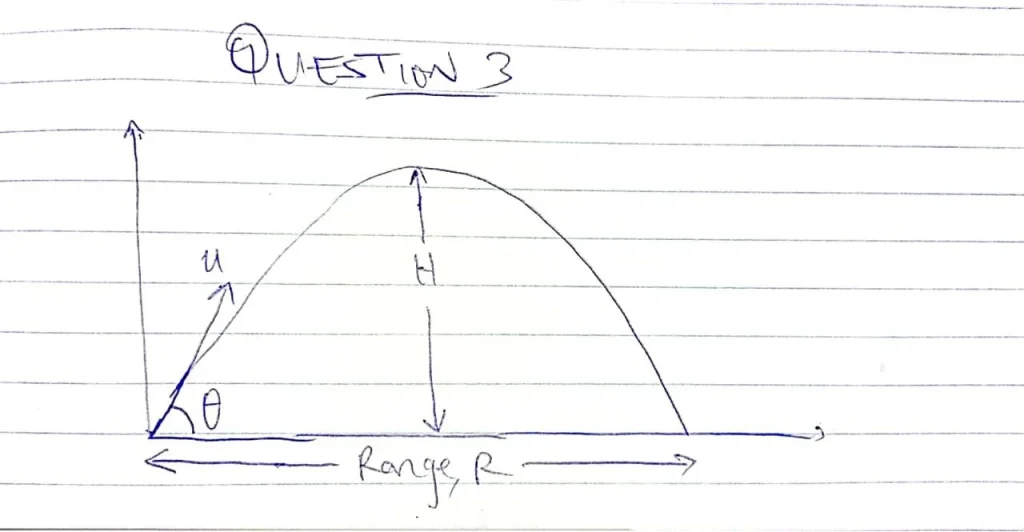
(1) R = (U²Sin2θ)/g Where: -U is the initial velocity (dimension: LT⁻¹, where L is length and T is time) -θ is the angle (dimensionless) -g is the acceleration due to gravity (dimension: LT⁻²) Now, let’s determine the dimension of R: R = (U²Sin2θ)/g R = U²/g = ((LT⁻¹)² / (LT⁻²) = (L²T⁻²) / (LT⁻²) = L
==================
Number 2
(2) (i) Gas Laser: Used in barcode scanners in supermarkets and retail stores. (ii) Chemical Laser: Used in military applications for missile defense and high-energy laser weapons. (iii) Dye Laser: Used in medical treatments such as removing birthmarks and vascular skin lesions.
==================
Number 3
==================
Number 4
==================
Number 5
(5) Given: Initial extension = 0.04 m when F = 6 N spring constant (k): k = F /e = 6 N / 0.04 m = 150 N/m New extension when F = 8 N: e = F / k = 8 N/150 N/m = 0.0533 m New length = Natural length + New extension = 5 m + 0.0533 m = 5.0533 m
Number 6
(6) (i) Laser light consists of a single wavelength, whereas white light comprises multiple wavelengths. (ii) Laser light waves are in phase (coherent), whereas white light waves are out of phase (incoherent). (iii) Laser light travels in a focused, directional beam, whereas white light disperses in various directions.
==================
Number 7
(7) (i) Retentivity Retentivity is the ability of a magnetic material to retain its magnetization even after the external magnetic field is removed. (ii) Iron
==================
Number 8
PART II: ANSWER THREE(3) QUESTIONS ONLY
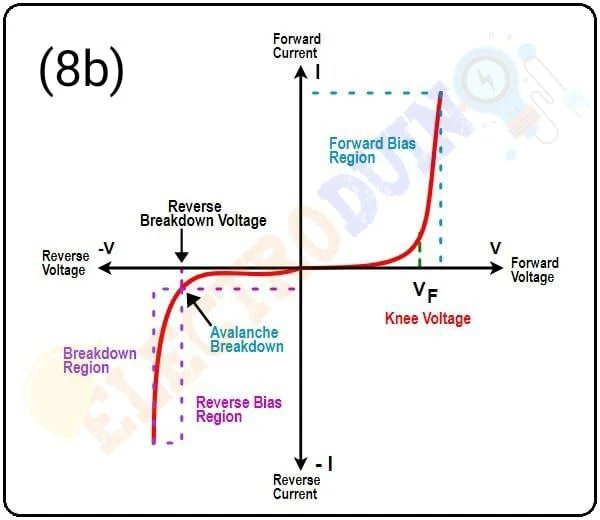
(8ai) A semiconductor is said to be doped when a small amount of impurity is intentionally added to a pure semiconductor to increase its electrical conductivity.
(8aii) I. Intrinsic semiconductor: An intrinsic semiconductor is a pure semiconductor material without any significant impurities added. II. Extrinsic semiconductor: An extrinsic semiconductor is a semiconductor that has been doped with impurity atoms (dopants) to increase its conductivity.
(8b)
(8c) Given: Wavelength (λ) = 3.0 × 10⁻⁷ m Kinetic energy (KE) = 1.5 × 10⁻¹⁹ J c = 3.0 × 10⁸ m/s mₑ = 9.1 × 10⁻³¹ kg h = 6.6 × 10⁻³⁴ Js
(i) Maximum velocity of the photoelectron KE = (1/2)mv² 1.5 × 10⁻¹⁹ J = (1/2) × 9.1 × 10⁻³¹ kg × v² v² = 2 × 1.5 × 10⁻¹⁹ J / (9.1 × 10⁻³¹ kg) v² = 3.3 × 10¹¹ v = √(3.3 × 10¹¹) v ≈ 5.74 × 10⁵ m/s
(ii) Work function of the metal E = hc / λ = (6.6 × 10⁻³⁴ Js × 3.0 × 10⁸ m/s) / (3.0 × 10⁻⁷ m) = 6.6 × 10⁻¹⁹ J
Work function (φ) = E – KE = 6.6 × 10⁻¹⁹ J – 1.5 × 10⁻¹⁹ J = 5.1 × 10⁻¹⁹ J
(8d) Stopping potential is defined as the minimum negative potential (voltage) applied to the collector electrode in a photoelectric experiment that just stops the most energetic photoelectrons emitted from reaching the collector.
==================
Number 9
(9a) Deformation refers to the change in shape or size of an object under an external force, while elasticity refers to the ability of an object to return to its original shape or size after the external force is removed.
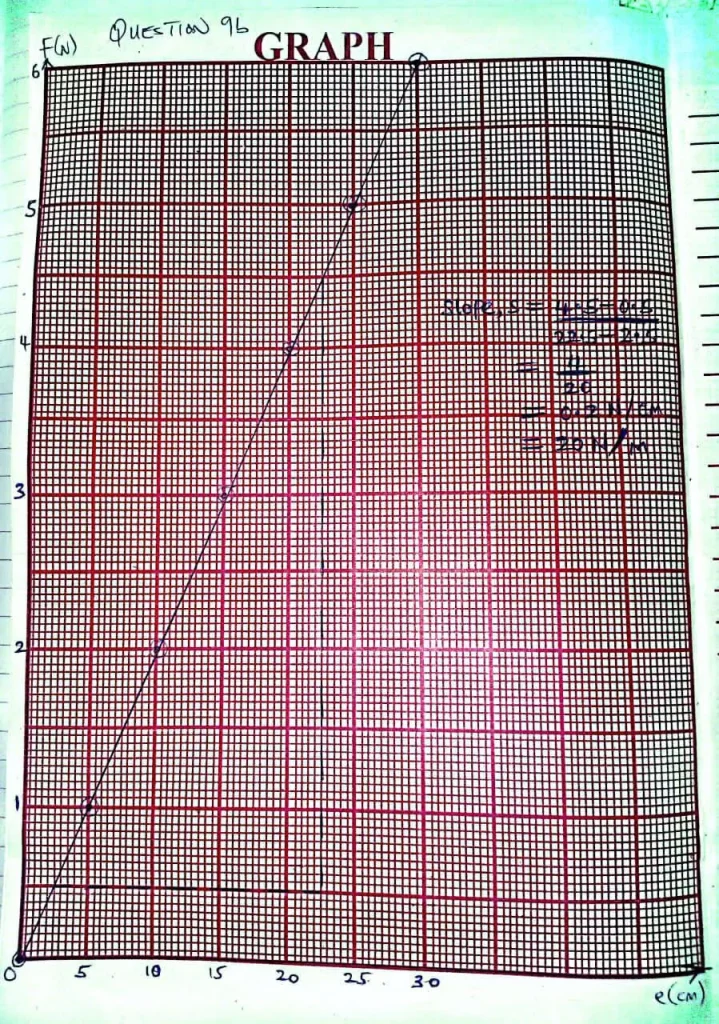
(9b)
(9bii) Slope = ∆F/∆e Point 1: (Extension = 10.0 cm, Force = 2.0 N) Point 2: (Extension = 30.0 cm, Force = 6.0 N) S = (6.0-2.0)/(30.0-10.0) S = 4.0/20.0 S = 0.2N/cm
(9biii) The slope represents the spring constant k, indicating the stiffness of the spring.
(9c) Given: Mass (m) = 40 g = 0.04 kg Elastic constant (k) = 350 N/m Extension (x) = 4 cm = 0.04 m Elastic potential energy stored in the rubber(E) = (1/2)kx² = (1/2) × 35 × (0.04)² (1/2) × 35 × 0.0016 = 0.28 J This energy is converted to kinetic energy of the stone: K = (1/2)mv² = E (1/2)mv² = 0.28 J (1/2) × 0.04 × v² = 0.28 v² = (2 × 0.28)/0.04 v² = 14 v = √14 v = 3.74 m/s
(9d) (i) Bulk modulus Bulk modulus is a measure of a material’s resistance to compression under uniform pressure. (ii) Energy gained by the wire Given: Mass (m) = 2.5g = 0.0025kg Extension (x) = 2cm = 0.02m g = 10m/s² Force (F) = mg = 0.0025 × 10 = 0.025N Energy gained (E) = (1/2)Fx = (1/2) × 0.025 × 0.02 = 2.5 × 10⁻⁴ J
==================
Number 10
(10a) (i) First overtone; The first overtone is the second harmonic of a vibrating system, having a frequency twice that of the fundamental frequency. (ii) End correction; End correction accounts for the fact that the antinode of a standing wave in a pipe doesn’t exactly coincide with the physical end.
(10b) Given: Length (L) = 40 cm = 0.4 m End correction (e) = 3.2 cm = 0.032 m Velocity of sound (v) = 330 m/s Effective length = L + e = 0.4 + 0.032 = 0.432m Wave length (λ)= 4Leff λ = 4×0.432 = 1.728m Frequency (f) = v/λ= = 330/1.728 = 191Hz
(10cii) (i) Mirage involves refraction and total internal reflection in air, while total internal reflection occurs at a medium boundary. (ii) Mirage produces an inverted image, while total internal reflection produces a mirror-like reflection.
(10ciii) Given: f₀ = 3 cm, fe = 6 cm, L = 20 cm v₀ = L – fe = 20 – 6 = 14 cm 1/f₀ = 1/v₀ – 1/u₀ 1/3 = 1/14 – 1/u₀ 1/u₀ = 1/14 – 1/3 1/u₀ = (3 – 14) / 42 1/u₀ = -11 / 42 u₀ = -42 / 11 u₀ = -3.82 cm